Your Food Sensitivity Test Might Be Lying to You (What to Track Instead)
I finally got the food sensitivity panel done. $199 dollars later, the results come back flagging chocolate, casein, coffee, and egg whites that I east almost daily. Naturally, I panicked — those are all staples in my diet that I love. So what's actually going on?
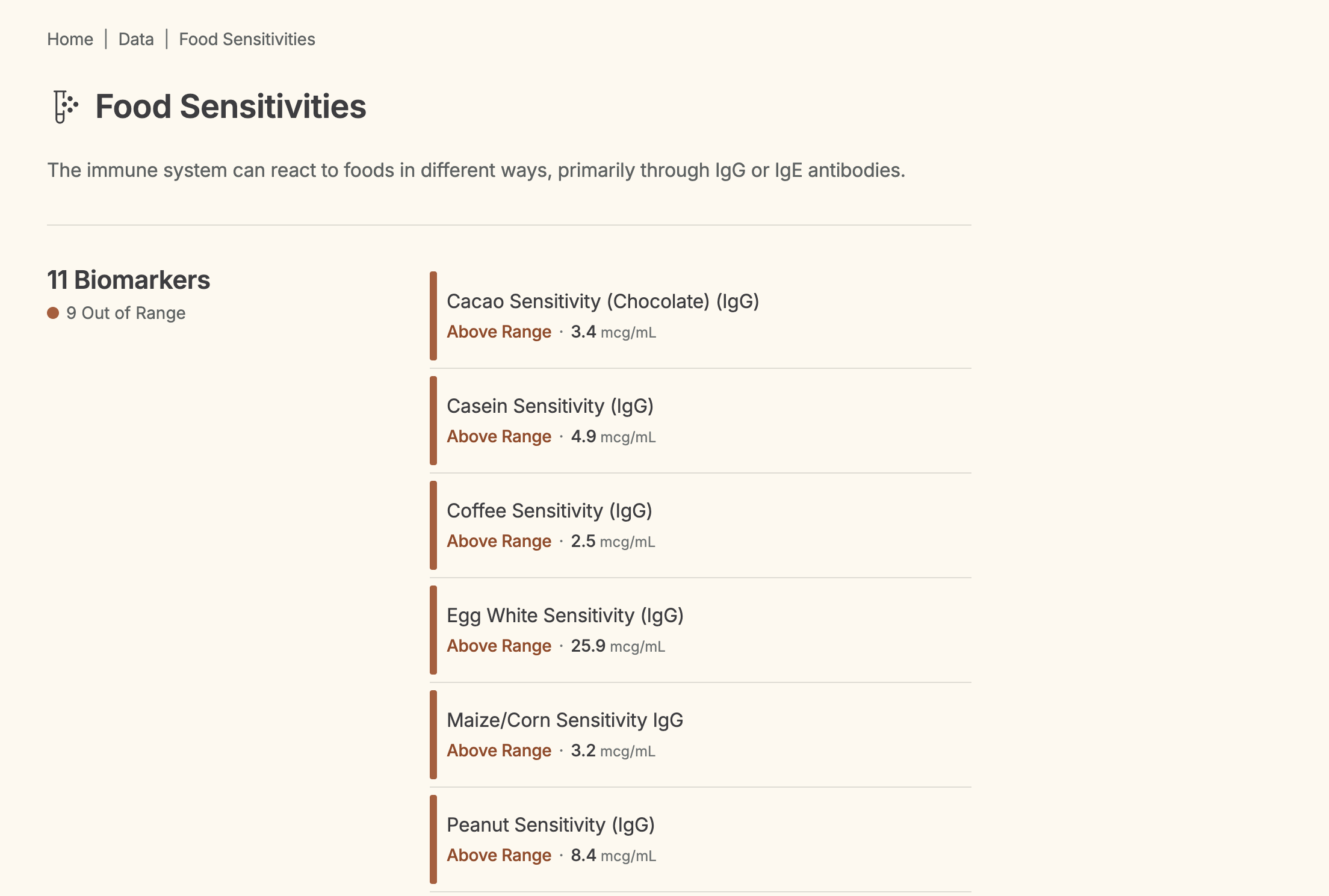
My food sensitivity results from Function Health
Nutrition coach Francesca Scerbo — who holds a master's in clinical nutrition and runs the practice Balanced Nutrition — has seen this exact scenario play out with her own clients, and with herself. "I had a food sensitivity test done on myself," she told me on the Fuel with Erin podcast. "And I eat a lot of greens and a lot of different types of vegetables. All of the stuff that I was eating was high on my food sensitivity test. And I'm thinking to myself, what am I gonna eat? I do nutrition coaching for a living."
Her explanation is simpler than you'd expect: "Sometimes what happens is the foods that we eat more frequently are the foods that tend to show up more, because it's the one thing that's always in your system." In other words, a sensitivity test isn't always measuring whether a food is harming you — sometimes it's just measuring how often that food is in your bloodstream. Eat kale five days a week, and don't be surprised when ehh whites up on the panel.
When Food Sensitivity Tests Are Actually Useful
Francesca isn't saying the tests are worthless across the board. "If you find that you're eating something and you're breaking out in hives or rashes, then the food sensitivity test is wonderful for that." The distinction matters: an acute, visible reaction is a different problem than a chronic low-grade "sensitivity" flagged on a lab panel because of how often you eat something.
So if a $199 test isn't the most reliable starting point, what is? Francesca's answer is refreshingly low-tech: pay attention to how you actually feel. "I want to know the basics — how do you feel after food? If people are feeling bloated, sluggish, they notice that their skin coloring's a little bit off, their hair maybe doesn't seem as vibrant, they have issues with their bowels."
And yes, she means the bowels specifically. "The GI system runs from the mouth all the way back to the end. So all of that has to be a play." Her rule of thumb, which she says catches most people off guard: you should be eliminating waste roughly twice a day. "If you are not using the restroom at least twice a day, then your body is holding on to toxins. It's actually building up with more inflammation and more toxic waste." If that number made you wince, you're not alone — most people default to "once a day, if that" and assume it's normal. Common isn't the same thing as optimal.

Francesca also points out a practical limitation of standard blood work that most people never consider: timing and food intake can quietly skew your results. "You can get blood work and have somebody not fast a full length of time. And the blood work can just be slightly skewed. I've had people that have had elevated liver enzymes because they had too much of one type of food for a couple of days that they normally didn't have." Standard labs (your typical LabCorp or Quest panel) also compare you against a wide population range, whereas more specialized functional or cellular-level testing looks at how your blood is behaving specifically — more useful, but also more expensive.
The Fiber Piece Nobody Talks About
The bathroom conversation leads naturally into fiber, which Francesca says is one of the most under- and over-corrected pieces of nutrition advice for women out there. "There used to be the old standard was around 20 grams of fiber a day. Then a lot of the hormone specialists and menopausal women physicians have come out saying, hey, we may need to bump this up to 50. If you think about it, 50 is a lot of fiber." Her actual recommendation lands in the middle: "I usually like to keep it right in the middle. Aim for 20. And then if you can go to 30, great."
The bigger caution is about how you get there. Reaching for fiber supplements or psyllium husk as a shortcut can backfire. "A lot of these fiber medications and certain things that people are using to supplement the food — which I honestly wouldn't do — could cause constipation, can cause stressing of the rectal muscles." Her preference is food first: flax, chia, or hemp seeds stirred into oatmeal or yogurt, a handful of berries, avocado (which she notes people forget has real fiber), and a daily salad built from something more substantial than iceberg lettuce.
The Label-Reading Rule That Cuts Through the Marketing
The same "what am I actually putting in my body" theme shows up again when Francesca talks about reading ingredient labels — and specifically, the current wave of "protein-washed" packaged snacks. "We're on a protein craze right now. So we see things like premier protein pancakes, protein pretzels, protein muffins, protein chips. There's no protein in there. It's a tagline."
Her rule of thumb for cutting through marketing noise on anything in a package: "If you cannot read the first five ingredients, don't buy it." She points to bread as the clearest example — a loaf from an actual bakery might have three or four ingredients, while a shelf-stable grocery store loaf can carry fifteen to twenty, simply because it needs to survive weeks on a shelf.
None of this, she's careful to add, means eating has to be joyless or perfect. It's the 80/20 rule in practice: "If you're doing the right things 80% of the time, that 20% is your play field." A cereal with four clean ingredients sprinkled on a protein bowl, a glass of wine on a Friday, a splash of oat milk in your coffee — none of it undoes the rest of the week if the baseline habits are solid.
The Takeaway
Before you spend money on another lab panel chasing a list of foods to eliminate, Francesca's advice is to start with what's observable: energy, skin, bloating, and yes, bathroom habits. Layer in a fiber target you can actually sustain with real food, and a five-second label check before anything with a "protein" claim goes in your cart. As she put it plainly: "Health is work. There's no two ways about it." But it doesn't have to be complicated to be effective.
Hear the full conversation with Francesca Scerbo — including her take on hydration, electrolytes, and why juice cleanses are a waste of your time — on the Fuel with Erin podcast.
